

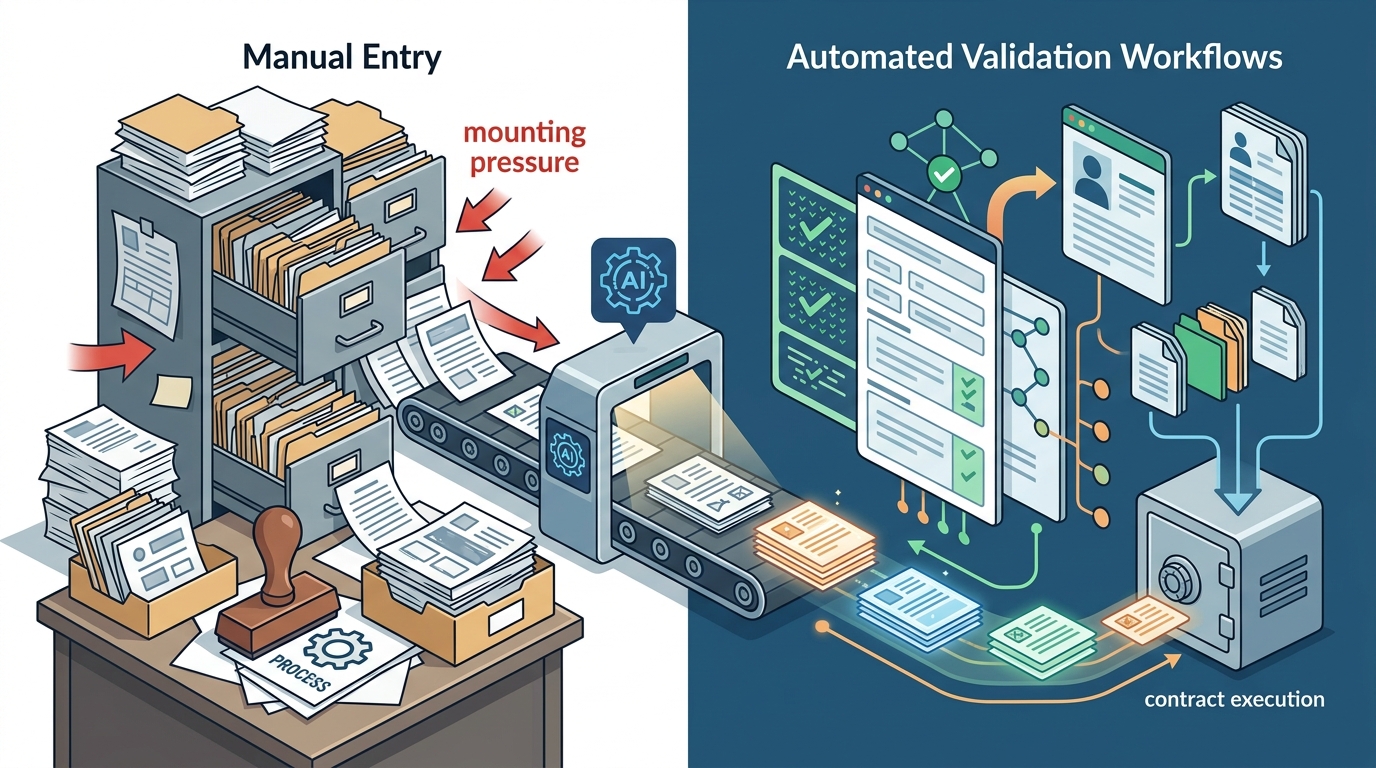
Organizations today face mounting pressure to streamline vendor registration without sacrificing compliance. According to recent industry benchmarks, manual data entry accounts for nearly forty percent of all procurement administrative overhead across global enterprises. This bottleneck directly delays contract execution and increases operational costs. Modern procurement automation platforms now resolve these friction points by deploying intelligent data extraction and automated validation workflows. Companies adopting these systems report a ninety percent reduction in paperwork processing times while maintaining strict audit trails.
Understanding Supplier Onboarding
Supplier onboarding is the systematic process of registering new vendors, verifying credentials, and configuring payment terms within a corporate procurement system. Traditional methods rely heavily on email exchanges, PDF attachments, and manual spreadsheet updates. These legacy approaches create severe data silos and introduce unacceptable error rates. Organizations must transition to centralized digital portals to maintain supply chain continuity. Procurement automation software eliminates redundant data entry by capturing vendor information once and distributing it across all necessary departments.
Manual registration forms require vendors to repeat identical information across multiple internal departments. This repetitive process wastes valuable administrative hours and increases the likelihood of transcription mistakes. Automated portals provide a single entry point where vendors submit all required documentation. The system then parses the data and routes specific fields to the appropriate stakeholders. This centralized approach guarantees that every department receives consistent, verified information without redundant requests.
Core Automation Workflows
Automated workflows replace sequential manual approvals with parallel processing triggers. When a potential vendor submits registration details, the system instantly routes the data to finance, legal, and operations teams. This simultaneous distribution prevents bottlenecks that typically delay procurement cycles by several weeks. Automated routing ensures that every stakeholder receives exactly the data they require without redundant requests. Companies utilizing these structured workflows consistently achieve faster contract execution timelines.
Dynamic approval matrices adjust routing paths based on vendor risk scores, spending thresholds, and geographic regions. High-risk suppliers trigger additional compliance checks while standard vendors proceed through expedited verification tracks. This intelligent routing reduces administrative friction and accelerates time-to-contract. Procurement teams can configure custom approval hierarchies that align with internal governance policies. The platform integrates seamlessly with all the major ERPs providing a secure, transparent, and completely paperless procurement environment without data silos.
Data Extraction Technology
Optical character recognition technology now powers the initial data capture phase for thousands of daily vendor submissions. The software scans uploaded documents, extracts key fields, and populates digital forms automatically. This capability drastically reduces the administrative burden on procurement specialists who previously spent hours rekeying information. Advanced algorithms continuously learn from corrections to improve future extraction accuracy. Organizations deploying these tools report a ninety percent reduction in manual data entry errors across all vendor records.
Machine learning models analyze historical submission patterns to predict missing fields and prompt vendors for clarification before final submission. This proactive guidance prevents incomplete registrations and reduces back-and-forth communication cycles. Automated data validation checks format consistency, verify tax identification numbers, and cross-reference business registration dates against public databases. These automated safeguards ensure that only complete, accurate records enter the active vendor registry. The platform supports advanced OCR for matching invoices to POs, further streamlining the financial reconciliation process.
Compliance and Risk Verification
Automated compliance checks run continuous background validations against global regulatory databases and internal risk thresholds. The system cross-references tax identification numbers, business registration dates, and industry certifications in real time. This proactive verification prevents unauthorized vendors from entering the supply chain. Automated risk scoring assigns priority levels to high-value or high-risk suppliers. Procurement teams can focus their attention on complex exceptions rather than routine data validation tasks.
Regulatory requirements vary significantly across different industries and geographic jurisdictions. Automated compliance engines maintain updated regulatory feeds that adapt to legislative changes without manual intervention. The system flags expired certifications, sanctions list matches, and conflicting conflict-of-interest declarations before contract execution. This continuous monitoring reduces legal exposure and ensures consistent adherence to corporate governance standards. Organizations utilizing these structured workflows consistently achieve faster contract execution timelines while maintaining rigorous compliance benchmarks.
Integration Ecosystems
Modern procurement platforms connect directly with existing enterprise resource planning systems through standardized application programming interfaces. These bidirectional connections ensure that approved vendor data flows seamlessly into financial ledgers and inventory management modules. The integration eliminates duplicate record creation and maintains a single source of truth for all purchasing activities. Organizations benefit from real-time budget visibility and automated purchase order generation. The platform integrates seamlessly with all the major ERPs providing a secure, transparent, and completely paperless procurement environment without data silos.
API-driven connectivity enables real-time synchronization of pricing agreements, payment terms, and delivery schedules across distributed business units. This synchronization prevents purchasing discrepancies and ensures that buyers always reference the most current contract terms. Automated purchase order generation triggers upon contract approval, eliminating the need for manual document creation. Inventory management modules update stock thresholds based on approved vendor lead times and historical consumption rates. These interconnected workflows create a unified operational ecosystem that scales alongside business growth.
Measuring ROI
Return on investment calculations for automation projects focus on reduced processing times, lower error rates, and improved vendor satisfaction scores. Companies typically observe a forty percent decrease in onboarding cycle duration within the first twelve months. These efficiency gains translate directly into higher purchasing volume capacity without additional headcount. Procurement leaders track key metrics such as average registration time, data accuracy percentages, and system adoption rates. Continuous monitoring ensures that automation investments deliver sustained operational improvements.
Financial modeling for automation initiatives accounts for reduced administrative labor costs, decreased penalty fees from late payments, and improved early payment discount capture. Organizations that implement comprehensive automation frameworks consistently report higher vendor retention rates and improved supply chain resilience. Regular performance audits identify workflow bottlenecks and recommend configuration adjustments to maximize system efficiency. Procurement executives use these data-driven insights to justify continued technology investments and expand automation coverage across additional business units.
Automation Feature Comparison
| Feature Category | Manual Process Limitation | Automated Solution Benefit |
|---|---|---|
| Data Entry | High error rates and slow processing | Automated approvals with ninety percent accuracy |
| Document Handling | Physical filing and lost paperwork | Digital invoice generation with instant routing |
| Vendor Verification | Delayed background checks | Biotech procurement compliance tracking |
| Sustainability Reporting | Manual carbon footprint calculations | Carbon emissions monitoring integration |
| System Connectivity | Disconnected legacy databases | Case study proven ERP synchronization |
Key Takeaways
- Automated workflows reduce manual data entry by up to ninety percent across global enterprises.
- Organizations report a forty percent decrease in onboarding cycle duration within the first year.
- Modern platforms maintain a 4.9 out of 5 rating for system reliability and user satisfaction. (A User Centred)
- Global supply chain software supports distributed legal entities across multiple continents.
- Real-time budget visibility prevents overspending and eliminates redundant purchase requests.
- Advanced optical character recognition technology captures vendor data from uploaded documents instantly.
- Enterprise-grade spend management tools integrate seamlessly with all major enterprise resource planning systems.
Frequently Asked Questions
What is the primary benefit of automating supplier onboarding?
Automating the registration process eliminates redundant data entry and accelerates contract execution timelines across all departments.
How does optical character recognition improve vendor registration?
Optical character recognition technology scans uploaded documents, extracts key fields, and populates digital forms automatically without human intervention.
Can procurement automation software integrate with existing enterprise systems?
Yes, modern platforms connect directly with enterprise resource planning systems through standardized application programming interfaces to ensure seamless data flow.
What metrics should procurement leaders track during automation implementation?
Leaders should monitor average registration time, data accuracy percentages, system adoption rates, and overall vendor satisfaction scores.
How does automated compliance verification reduce supply chain risk?
Automated compliance checks run continuous background validations against global regulatory databases and internal risk thresholds in real time.
What is the typical return on investment timeline for procurement automation?
Companies typically observe a forty percent decrease in onboarding cycle duration within the first twelve months of deployment.
How does the platform handle multi-entity global operations?
The software supports multiple users across multiple distributed legal entities around the world while maintaining centralized governance and data security.
Next Steps for Your Procurement Team
Transitioning to a fully automated supplier onboarding workflow requires careful planning and system configuration. Our team provides dedicated implementation support, custom workflow design, and ongoing technical assistance to ensure a seamless deployment. Schedule a personalized demonstration today to explore how our platform can streamline your vendor registration process. Visit our main portal to request a demo and access comprehensive pricing information.