

Connecting your procurement management tools with an existing ERP system is one of the most impactful upgrades a business can make. When done right, integration eliminates duplicate data entry, accelerates approval workflows, and gives finance and procurement teams a single source of truth. Yet many organizations struggle with disconnected systems that create data silos, delayed approvals, and uncontrolled spending. This guide walks you through the practical steps, common pitfalls, and best practices for a smooth procurement-ERP integration, whether you run SAP, Oracle, NetSuite, or another platform.
Why Procurement-ERP Integration Matters
Most organizations already rely on an ERP system for finance, accounting, and operational data. However, ERP platforms alone cannot fully support everyday procurement activities such as supplier onboarding, sourcing, and spend analysis. When procurement runs on a separate tool with no data bridge, teams are forced to transfer information manually between platforms, creating communication gaps and errors.
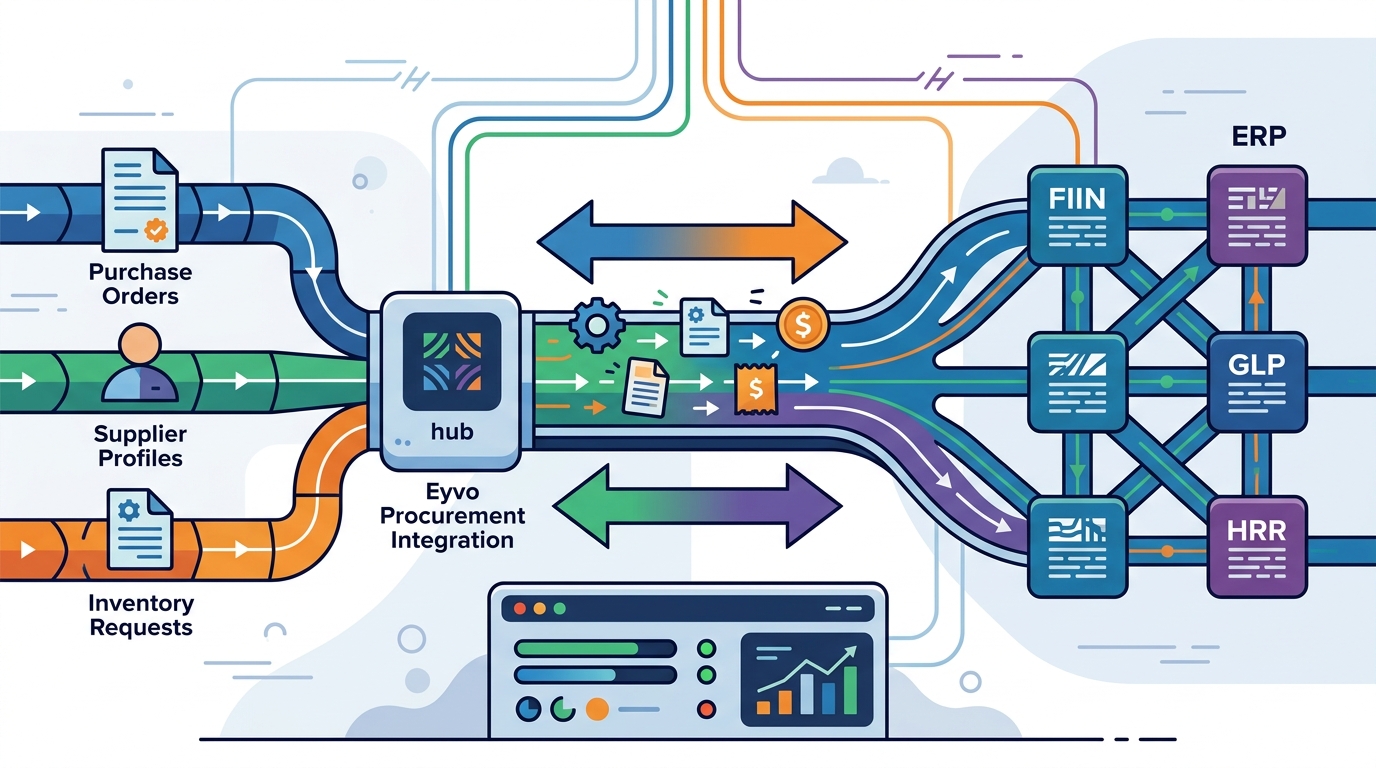
An integrated system provides real-time access to procurement data, letting you track orders, supplier performance, and spending far more effectively. It also bridges communication between procurement, finance, and operations by providing a shared resource for approvals and reporting. Solutions like Eyvo's procurement software are designed to integrate effortlessly with existing ERP systems and accounting tools to ensure smooth data synchronization and reduce manual work.
Key Terms You Should Know
ERP (Enterprise Resource Planning)
An ERP system is a software solution that helps organizations manage and integrate their core business processes on a centralized platform, covering finance, HR, inventory, and more.
Procure-to-Pay (P2P)
Procure-to-pay is the end-to-end process that covers requisitioning, purchasing, receiving, and paying for goods and services. Modern P2P platforms bundle workflows with contract management and real-time analytics so you do not need to stitch together separate tools.
API (Application Programming Interface)
An API is a set of protocols that allows two software applications to communicate and share data automatically, forming the backbone of most modern integrations.
Step-by-Step Integration Process
1. Audit Your Current Systems
Start by mapping every tool that touches procurement data: your ERP, accounting software, spreadsheets, and email-based approval chains. Identify where manual handoffs occur and where data breaks down. This audit creates the baseline for your integration scope.
2. Define Data Flows and Business Rules
Decide which data objects need to sync: purchase requisitions, purchase orders, goods receipts, invoices, and supplier master records. Set business rules for approval thresholds, budget checks, and duplicate detection. Eyvo's integration module supports standardized connectors that map these objects directly to your ERP fields.
3. Choose Your Integration Method
Select from API-based, middleware, or file-based integration depending on your ERP version, IT resources, and data volume. Cloud-based procurement platforms typically offer pre-built connectors for major ERPs, which dramatically reduce setup time. It is crucial to choose solutions that provide standardized integration adapters that remain certified when your ERP is upgraded.
4. Test in a Sandbox Environment
Run integration tests with sample purchase orders, invoices, and supplier records before going live. Validate that data maps correctly, approval workflows trigger as expected, and error handling routes exceptions to the right team. The typical implementation timeline for cloud procurement deployment ranges from 3 to 6 months for initial go-live.
5. Go Live and Monitor
Deploy in phases, starting with a pilot department. Monitor sync logs, exception queues, and user adoption metrics daily for the first two weeks, then weekly thereafter. Use procurement analytics dashboards to track order accuracy and cycle times in real time.
Common Challenges and How to Avoid Them
One of the most cited challenges is failure to integrate eProcurement with existing ERP solutions. Many SaaS tools have strict requirements for ERP connectivity, so it pays to verify certified adapters before you sign a contract. Cloud-based solutions can allow you to streamline and standardize processes, but only if the integration layer is well-architected.
A second common pitfall is poor supplier onboarding. Procurement solutions that support batch supplier enablement through a centralized hub provide greater scalability. Eyvo's vendor portal connects buyers and suppliers through direct integration or web portals, reducing the manual burden of maintaining supplier data.
According to Deloitte research cited by Spendflo, nearly 70% of procurement leaders say they struggle to manage vendors efficiently due to disconnected systems and manual approvals. Planning for these pain points from day one makes the difference between a smooth rollout and a costly rework.
Integration Methods Compared
| Method | Best For | Setup Time | Maintenance | Real-Time Sync |
|---|---|---|---|---|
| Native API connectors | Cloud ERP users (NetSuite, SAP S/4HANA) | 2-6 weeks | Low | Yes |
| Middleware / iPaaS | Complex multi-ERP environments | 4-12 weeks | Medium | Yes |
| Flat-file / CSV import | Legacy or on-premise ERPs | 1-2 weeks | High (manual) | No (batch) |
| Custom point-to-point | Unique or proprietary systems | 8-16 weeks | High | Varies |
For most mid-market organizations, native API connectors offer the best balance of speed and reliability. Eyvo's platform supports third-party integrations with ERP software, messaging apps like Microsoft Teams and Slack, and accounting tools out of the box.
Measurable Benefits of a Connected System
Organizations that invest in procurement digitization achieve their cost savings targets 96% of the time versus 80% for laggards, according to research highlighted by Ivalua. AI-enabled procurement can deliver 25 to 40% efficiency gains on top of that.
Public sector organizations that implement eProcurement experience 20 to 30% savings through maverick spend reduction and strategic sourcing. The global procurement software market is projected to grow from $8.2 billion in 2024 to $17.5 billion by 2033, according to IMARC Group data cited by DOSS, signaling that integration-ready platforms are becoming the standard, not the exception.
With Eyvo's eProcurement platform, businesses gain real-time visibility and insights into the procurement lifecycle with customizable dashboards, automated approval workflows, 3-way invoice matching, and seamless ERP synchronization.
Key Takeaways
- Disconnected procurement and ERP systems lead to manual data entry errors, delayed approvals, and limited spend visibility.
- Start every integration project with an audit of current data flows and a clear mapping of business rules.
- Choose certified, standards-based connectors over custom point-to-point integrations whenever possible.
- Cloud-based procurement platforms like Eyvo offer pre-built ERP adapters that cut deployment time to weeks rather than months.
- Test thoroughly in a sandbox before going live, and roll out in phases to manage risk.
- Procurement digitization can deliver cost savings targets up to 96% of the time and 25-40% efficiency gains with AI.
- The procurement software market is projected to nearly double by 2033, making integration readiness a competitive necessity.
Frequently Asked Questions
What is procurement-ERP integration?
Procurement-ERP integration is the process of connecting a dedicated procurement management tool with an Enterprise Resource Planning system so that data such as purchase orders, invoices, and supplier records flows automatically between both platforms without manual re-entry.
Which ERP systems can integrate with procurement software?
Most modern procurement platforms support integration with major ERPs including SAP S/4HANA, Oracle Cloud, Microsoft Dynamics 365, and NetSuite. Eyvo, for example, offers standardized connectors and an open integration module for a wide range of ERP and accounting systems.
How long does a procurement-ERP integration take?
Cloud-based integrations using native API connectors typically take 2 to 6 weeks. More complex middleware setups for multi-ERP environments can take 4 to 12 weeks. Full deployment, including user training and phased rollouts, generally ranges from 3 to 6 months.
What are the biggest risks of a failed integration?
The main risks include data duplication, broken approval workflows, compliance gaps, and increased maverick spending. Many failures stem from choosing tools with non-certified ERP adapters or skipping the sandbox testing phase.
Can small businesses benefit from procurement-ERP integration?
Absolutely. Cloud-based solutions with lower upfront costs and faster implementation times are increasingly favored by small and mid-sized businesses. Eyvo's software is designed to scale and adapt, making it suitable for organizations of all sizes.
Do I need to replace my ERP to integrate procurement tools?
No. A well-designed procurement platform sits alongside your ERP and enhances it. The goal is to centralize procurement-specific functions like sourcing, supplier management, and spend analytics without disrupting your core ERP infrastructure.
How does integration improve compliance?
Procurement software integrated with an ERP helps enforce compliance with internal policies and external regulations by providing tools to track contract terms, regulatory requirements, and supplier performance, significantly reducing non-compliance risk.
What role does AI play in procurement integration?
AI enhances integrated procurement by automating invoice matching, flagging spend anomalies, scoring supplier risk, and forecasting demand. These capabilities rely on clean, connected data, which is exactly what a solid ERP integration provides.
Ready to Connect Your Procurement and ERP Systems?
Stop toggling between disconnected tools and start making procurement data work for your entire organization. Eyvo's AI-powered eProcurement platform integrates with your existing ERP in weeks, not months, and is fully customizable to your business rules. Request a free demo today and see how seamless integration transforms your procurement workflow.