

Digitizing the Purchase-to-Pay Cycle: How It Improves Spend Visibility and Budget Control
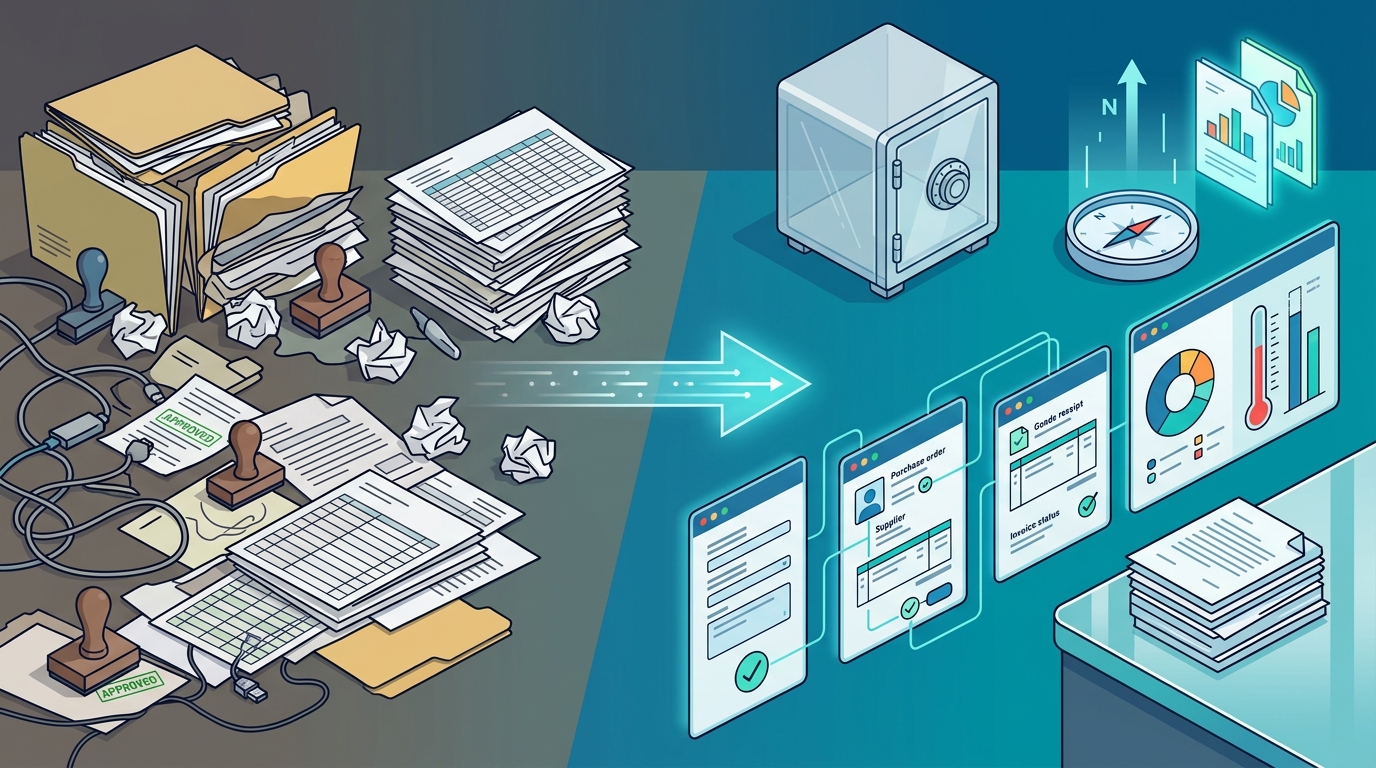
Organizations that still rely on paper forms, spreadsheets, and emailed approvals for purchasing are flying blind. They lack real-time insight into what is being spent, by whom, and whether it aligns with approved budgets. Digitizing the purchase-to-pay (P2P) cycle replaces those manual hand-offs with an automated, transparent workflow that captures every transaction from requisition to final payment. The result is dramatically better spend visibility and tighter budget control. In this guide, we break down how each stage of a digital P2P cycle contributes to smarter financial management and what the latest industry data says about the impact.
What Is the Purchase-to-Pay Cycle?
The purchase-to-pay (P2P) cycle is the end-to-end process an organization follows to request, approve, order, receive, and pay for goods and services. Procure-to-pay (P2P) is a crucial process in any organization that involves the procurement of goods and services and the subsequent payment to suppliers. It spans multiple departments, from the requestor and budget holder to procurement, receiving, and accounts payable.
A typical P2P cycle includes these stages: requisition creation, purchase order approval, supplier order placement, goods receipt, and invoice payment. When managed manually, each hand-off introduces delays, data-entry errors, and gaps in oversight. A digital procurement software platform eliminates those gaps by connecting every stage in a single system.
The Spend Visibility Problem in Manual Procurement
Without a centralized system, procurement data lives in filing cabinets, email threads, and disconnected spreadsheets. Budget holders may not know a purchase order has been raised against their cost center until the invoice arrives weeks later. This lack of transparency is a breeding ground for maverick spending, which is unauthorized purchasing that bypasses approved contracts and suppliers.
Many prospective clients come to digital procurement providers struggling with old existing systems that are either completely based on paper or on a mixture of spreadsheets and emailed approvals. There is often no accountability, approval chain, or strong audit trail showing who wants what, why they want it, and who authorized the purchase. According to Ardent Partners' 2025 research, average spend under management across organizations has climbed to 71%, the highest in their 20-year research history, yet that still means nearly a third of organizational spend remains outside procurement's direct control.
How Digitization Transforms Every P2P Stage
Requisition and Approval Automation
Digital requisition tools let employees submit purchase requests through a straightforward web form that enforces predetermined business rules and approval workflows. Solutions like Eyvo's Purchase Requisition Module support catalogue selection, free-text entry, cost splitting with budget checks, and multi-level approvals. This means every request is captured, categorized, and routed automatically, giving finance teams instant visibility into incoming demand.
Purchase Order Management
Once approved, the requisition converts to a purchase order (PO) that is approved and emailed to the supplier with minimal time delay. A centralized purchase order software system not only helps curtail unwanted or unapproved spending but also assists in seeing overall spend through management reports. Real-time PO tracking ensures budget holders sign off on final costs before commitments are made to vendors.
Mobile and Remote Access
Modern procurement platforms extend visibility beyond the desktop. With mobile procurement software, managers can approve requests, track budgets, and manage supply chain actions from their smartphones, ensuring approvals are never bottlenecked by someone being away from their desk.
Real-Time Budget Control Through Automation
Budget control is the practice of monitoring and enforcing spending limits across departments, projects, and cost centers before purchase commitments are made. A digital P2P system shows available budgets before placing an order, which gives decision-makers more control. When a requisition is submitted, the system checks it against the allocated budget in real time and can block or flag requests that would exceed the threshold.
Eyvo's cloud-based solution provides real-time spend analysis and insights, enabling organizations to identify trends and see when budgets are about to get out of hand. You can report on spend by category, division, country, vendor, or business unit, ensuring granular oversight that was impossible with manual processes.
| Capability | Manual Process | Digitized P2P |
|---|---|---|
| Budget visibility | End-of-month reports only | Real-time dashboards |
| Approval speed | Days to weeks (paper routing) | Minutes to hours (automated workflows) |
| Maverick spend detection | Discovered at audit | Blocked at requisition |
| Spend categorization | Manual spreadsheet analysis | Automatic tagging and reporting |
| Audit trail | Paper files, email chains | Full electronic log per transaction |
Invoice Matching and Closed-Loop Procurement
Spend visibility does not end when the PO is sent. The final and often most error-prone stage is invoice processing. Closed-loop procurement is a checks-and-balances approach where you request it, order it, receive it, and pay for it, with each step verified against the last. The objective is to ensure you only get invoiced for what you ordered and you only pay for what you received, a process called a 4-way match.
Eyvo's Invoicing module uses OCR technology to scan supplier invoices and supports 3-way and 4-way matching. The system ensures the order value matches the received value, which matches the invoiced and payment values. Only when all figures equate does the system close the transaction, dramatically reducing overpayments and duplicate invoices.
Industry Data: The Business Case for P2P Digitization
The momentum behind procurement digitization is backed by hard numbers. According to Ardent Partners' 2025 State of Source-to-Pay Digitization report, 53% of Chief Procurement Officers increased their S2P technology budget compared to the previous year, a significant jump from just 30% in 2024. Additionally, 90% of CPOs anticipate 2025 to be more challenging than 2024, with the top priority being cost savings (71%).
Spend under management is a critical metric. Ardent Partners data cited by Esker indicates that every new dollar of spend placed under procurement's control can result in 6-12% savings, while best-in-class organizations achieve 91.5% spend under management compared to an average of 57.1%. These numbers underscore why digitizing the P2P cycle is not just an operational improvement but a strategic financial lever.
Real-world case studies reinforce this. Hewlett-Packard, one of the earliest adopters of spend management tools, achieved over $1.8 billion in spend reduction after implementing e-procurement, with contract compliance reaching an estimated 80%, as highlighted in Eyvo's analysis of global eProcurement implementations.
Key Takeaways
- The purchase-to-pay cycle is the complete workflow from requisition to supplier payment; digitizing it creates a single source of truth for all procurement data.
- Manual P2P processes leave nearly a third of organizational spend outside procurement's control, increasing maverick spending and budget overruns.
- Automated requisition and PO workflows enforce business rules, budget checks, and approval chains before any commitment is made.
- Real-time dashboards replace end-of-month reports, giving finance teams instant visibility into spend by category, supplier, and department.
- Closed-loop procurement with 3-way or 4-way invoice matching prevents overpayments and strengthens audit readiness.
- Industry research shows that 53% of CPOs increased their S2P technology budgets in 2025, signaling strong confidence in digital procurement ROI.
- Best-in-class organizations achieve 91.5% spend under management, with each dollar under control yielding 6-12% savings.
Frequently Asked Questions
What is the purchase-to-pay cycle?
The purchase-to-pay cycle is the end-to-end procurement process that starts with a purchase requisition and ends with supplier payment. It includes requisition creation, PO approval, ordering, goods receipt, and invoice settlement.
How does digitizing P2P improve spend visibility?
A digital P2P platform captures every transaction in a centralized system, providing real-time dashboards and reports. This means finance teams can see what is being spent, by which department, and against which budget at any moment.
What is maverick spending?
Maverick spending is unauthorized purchasing that bypasses approved procurement channels, contracts, or preferred suppliers. Digital P2P systems reduce maverick spend by enforcing business rules and routing all purchases through controlled approval workflows.
What is a 4-way match in invoice processing?
A 4-way match verifies that four data points align: the purchase order value, the received goods value, the invoice amount, and the payment amount. When all four match, the transaction is closed with full confidence that you paid only for what was ordered and received.
How quickly can organizations see ROI from P2P digitization?
Many organizations begin seeing efficiency gains within weeks of implementation through faster approvals and reduced data-entry errors. Strategic savings from better spend visibility and contract compliance typically accumulate over the first 6 to 12 months.
Does P2P software integrate with existing ERP systems?
Yes. Leading eProcurement solutions like Eyvo's eBuyerAssist are designed for seamless integration with third-party software, including ERPs, accounting systems, and payment platforms via API connections.
Is P2P digitization only for large enterprises?
No. Cloud-based P2P platforms are modular and scalable. Eyvo, for example, lets organizations select only the modules they need, so businesses of all sizes can benefit from better control and analytics without paying for unnecessary features.
What role does AI play in P2P digitization?
AI enhances P2P systems through capabilities like spend forecasting, supplier discovery, automated invoice scanning via OCR, and intelligent spend categorization. According to Ardent Partners, roughly one in four procurement teams had integrated some form of AI into standard procurement activities by 2025, and that number is growing rapidly.
See How Eyvo Can Transform Your Purchase-to-Pay Process
Ready to replace spreadsheets and paper approvals with real-time spend visibility and automated budget control? Explore Eyvo's eProcurement software and request a personalized demo to see how our AI-powered platform can digitize your entire P2P cycle, from requisition to payment, in one cloud-based solution.