

How Digitizing the Purchase-to-Pay Cycle Improves Spend Visibility and Budget Control
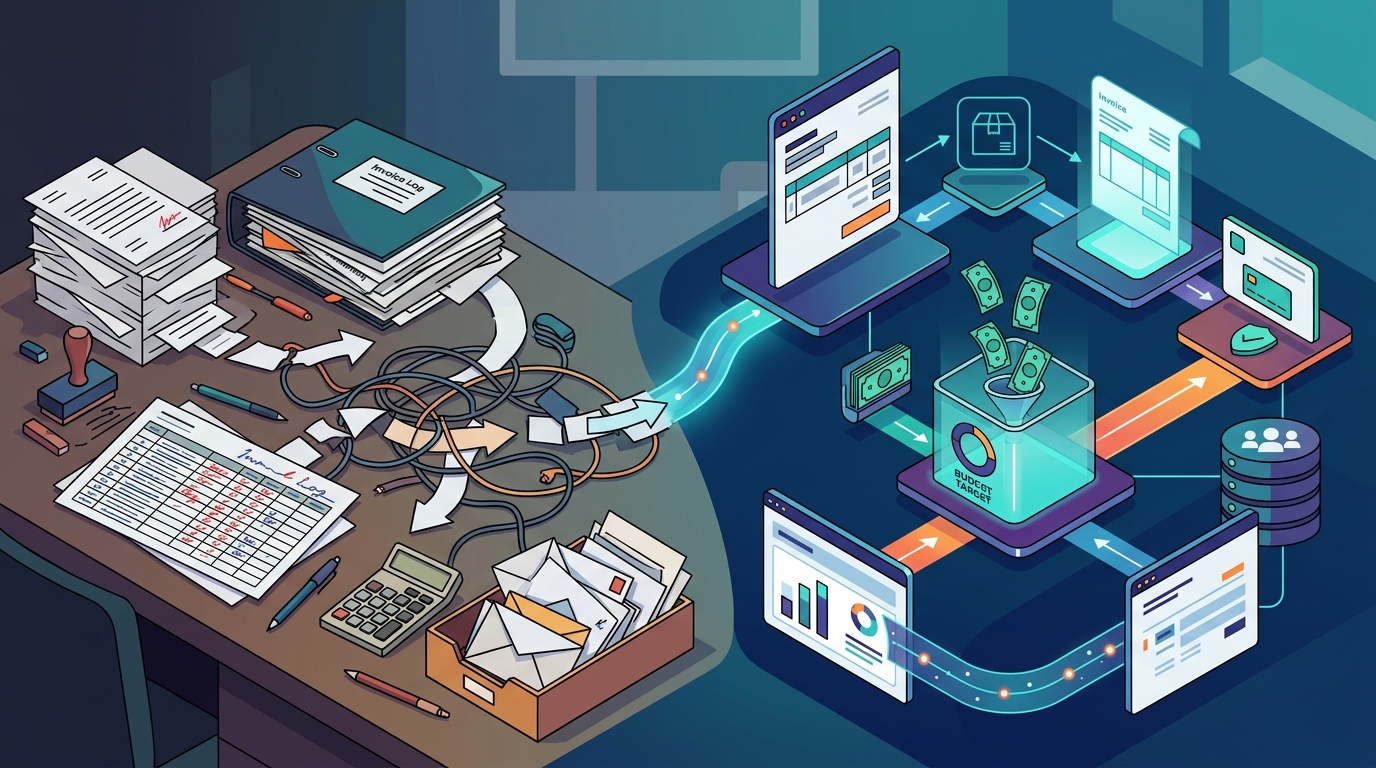
Organizations that still rely on paper requisitions, spreadsheet tracking, and manual invoice processing are flying blind when it comes to spend management. The purchase-to-pay (P2P) cycle is the series of steps that takes a buying need from initial request through to final supplier payment. Digitizing this cycle replaces fragmented, error-prone workflows with a single, transparent platform that captures every transaction in real time. The result is dramatically better spend visibility, tighter budget control, and measurable cost savings. In this guide, we explore exactly how a digital P2P transformation delivers those outcomes and what you should look for in a solution.
What Is the Purchase-to-Pay Cycle?
Procure-to-pay (P2P) is the end-to-end process that covers identifying a purchasing need, raising a requisition, issuing a purchase order, receiving goods or services, and paying the supplier invoice. It is the backbone of procurement operations in every organization, regardless of size or sector.
Each stage carries its own data: cost estimates, approval signatures, delivery confirmations, and payment records. When these stages are handled on paper or across disconnected systems, critical spending data gets lost between departments. A modern procurement software platform captures that data at a single point of entry, ensuring nothing falls through the cracks.
Pain Points of Manual P2P Processes
Manual procurement workflows create significant financial risk. Research suggests that processing a single invoice manually costs organizations between $12 and $20, according to Versa Cloud ERP analysis. Multiply that across thousands of annual transactions and the waste becomes staggering.
Common Manual P2P Problems
- Scattered documentation across spreadsheets, emails, and filing cabinets
- No real-time view of committed spend versus available budget
- Delayed approvals that miss early-payment discounts
- Duplicate or unauthorized purchases (maverick spending)
Industry estimates indicate that a poorly functioning P2P process can waste 3 to 5% of total supply chain spend. For a mid-sized organization spending $50 million annually, that translates to $1.5 to $2.5 million in preventable losses.
How Digitization Unlocks Spend Visibility
Spend visibility is the ability to monitor, categorize, and analyze all expenditures across every department and supplier in real time. Without it, finance leaders cannot answer basic questions: Who is spending what? With which suppliers? Against which budgets?
A digital P2P platform centralizes every requisition, purchase order, receipt, and invoice in one system. Eyvo's spend tracking and budgeting tools give procurement teams real insight into spend patterns and alert users when payments are overdue or budgets are at risk. With eProcurement, organizations achieve transparency on spending, purchasing, costs, and expenses, including real-time statistics on unauthorized purchases and corporate expenditures.
From Reactive to Proactive
Instead of waiting for month-end reports, procurement leaders can monitor spend in real time and adjust allocations instantly. This helps prevent budget overruns and supports agile financial planning. Data from IBM confirms that automated P2P systems provide real-time visibility into spending patterns and procurement activities, enabling organizations to monitor budgets and make informed financial decisions.
Strengthening Budget Control Through Automation
Budget control is the practice of setting spending limits by department, project, or cost center and enforcing those limits through approval workflows. Digital P2P tools make this enforcement automatic rather than relying on human memory.
Eyvo's Purchase Requisition Module supports cost splitting with budget checks, multi-level approvals, and configurable business rules that the system enforces before any order reaches a supplier. This means every purchase is validated against the correct budget before commitment.
Approval at the Right Stage
A common mistake is approving at the requisition stage rather than the purchase order stage. As Eyvo's procurement experts note, a requisition is simply an "I would like to buy" document with no commercial weight. The purchase order is the legal contract, and budget holders should sign off at that point to ensure accuracy and accountability.
Closed-Loop Procurement and the 4-Way Match
Closed-loop procurement is a checks-and-balances approach that tracks every transaction from request to payment. Eyvo uses the concept of closed-loop procurement to ensure you only get invoiced for what you ordered and you only pay for what you received. This 4-way match (order, delivery, invoice, payment) closes the loop on each transaction and dramatically reduces payment errors and fraud.
Automated matching also accelerates invoice processing, enabling organizations to capture early-payment discounts that manual teams typically miss.
AI-Powered Analytics and Real-Time Reporting
Modern P2P platforms go beyond simple automation by embedding artificial intelligence into procurement workflows. Eyvo's AI-driven updates deliver faster procurement processes, efficient supplier selection, and spend forecasting capabilities. Using the spend management platform, teams can identify trends and see when budgets are about to get out of hand.
According to Coupa's benchmark data, best-in-class companies using P2P automation increase visibility by 24.4% in managed spend and save 8.1% on overall spend. Studies also suggest that fully optimized P2P automation can deliver up to a 30% reduction in procurement costs.
Manual vs. Digital P2P: A Side-by-Side Comparison
| Capability | Manual P2P | Digital P2P |
|---|---|---|
| Spend visibility | Limited; relies on month-end reports | Real-time dashboards across all departments |
| Invoice processing cost | $12 to $20 per invoice | Significantly reduced through automation |
| Approval cycle time | Days to weeks | Hours (best-in-class: 4 business hours) |
| Maverick spending control | Minimal enforcement | Policy-driven, system-enforced rules |
| Audit trail | Paper-based, fragmented | Complete digital record, SOX-ready |
| Budget tracking | Retrospective | Pre-commitment checks in real time |
| Supplier payment accuracy | Error-prone manual matching | Automated 4-way match |
Key Takeaways
- Digitizing P2P replaces fragmented paper workflows with a single source of truth for all procurement data.
- Real-time spend visibility lets finance teams catch budget overruns before they happen, not after.
- Automated approval workflows enforce budget limits and procurement policies without manual intervention.
- Closed-loop procurement with 4-way matching eliminates duplicate payments and invoice fraud.
- AI-powered analytics surface cost-saving opportunities that manual analysis cannot detect at scale.
- Best-in-class organizations report up to 24% more managed spend visibility and 8% overall savings after P2P automation.
- The cost of inaction is real: manual P2P inefficiencies can waste 3 to 5% of total supply chain spend.
Frequently Asked Questions
What is purchase-to-pay (P2P)?
Purchase-to-pay is the end-to-end process of procuring goods and services, receiving them, and making payments to suppliers. It spans requisition, purchase order creation, goods receipt, invoice verification, and payment execution.
How does digitizing P2P improve spend visibility?
A digital P2P platform centralizes all purchasing and payment data in one system, providing real-time dashboards that show spending by department, supplier, category, and budget. This eliminates the blind spots created by scattered spreadsheets and siloed departments.
What is maverick spending and how does P2P software reduce it?
Maverick spending is unauthorized or off-contract purchasing that bypasses approved suppliers and negotiated rates. P2P software reduces it by enforcing standardized workflows, preferred supplier catalogs, and automated budget checks before any order is placed.
What is a 4-way match in procurement?
A 4-way match compares four documents: the purchase order, the goods receipt, the supplier invoice, and the payment authorization. If all four align, the transaction is complete. This process prevents overpayment and invoice fraud.
How much can organizations save by automating P2P?
Savings vary by organization size and maturity. Industry benchmarks suggest up to 30% reduction in procurement costs, with leading companies reporting 8% savings on overall spend and requisition-to-order cycle times as low as four hours.
Does Eyvo's eProcurement software support budget tracking?
Yes. Eyvo's platform includes spend tracking and budget management features that provide real-time alerts, trend analysis, and cost-center-level visibility so finance teams can act before budgets are exceeded.
Can P2P software integrate with existing ERP and finance systems?
Most modern P2P platforms, including Eyvo's eProcurement solution, integrate with existing ERP and accounting systems to exchange master and transactional data, ensuring procurement aligns with broader financial operations.
Is digital P2P suitable for small and mid-sized organizations?
Absolutely. Cloud-based P2P solutions offer scalable pricing and modular features. Eyvo, for example, lets you select only the modules you need, so you pay for what you actually use rather than an entire system full of features that do not fit your requirement.
Ready to Transform Your Procurement Spend Visibility?
If your organization is still managing purchases with spreadsheets and email approvals, you are leaving savings on the table. Eyvo's AI-powered eProcurement platform gives you real-time spend visibility, automated budget controls, and closed-loop procurement from day one. Request a free demo and see how digitizing your purchase-to-pay cycle can deliver measurable results.