

Digitizing the Purchase-to-Pay Cycle for Better Spend Visibility and Budget Control
The purchase-to-pay (P2P) cycle is the financial backbone of every procurement operation, yet many organizations still manage it with spreadsheets, email chains, and paper-based approvals. The result? Poor spend visibility, budget overruns, and maverick purchasing that quietly drains value. Digitizing P2P transforms this fragmented process into a transparent, real-time workflow where every dollar is tracked from requisition to final payment. In this guide, we break down exactly how a digital P2P cycle improves spend visibility and budget control, the key stages involved, and what to look for in a solution.
What Is the Purchase-to-Pay Cycle?
The purchase-to-pay cycle is the end-to-end process an organization follows to request, procure, receive, and pay for goods and services. It begins when an employee submits a purchase requisition and ends when the supplier invoice is settled. Procure-to-pay (P2P) is a crucial process in any organization that involves the procurement of goods and services and the subsequent payment to suppliers.
A well-structured procure-to-pay workflow typically includes need identification, requisition creation, approval routing, purchase order issuance, goods receipt, invoice verification, and payment execution. Each stage generates data that, when captured digitally, becomes a source of actionable insight.
The Spend Visibility Gap in Manual Procurement
In traditional environments, purchasing and accounts payable often operate as separate silos. Information lives in disconnected spreadsheets, emails, and filing cabinets. This fragmentation means leadership cannot see the full picture of organizational spend in real time.
Common Symptoms of Poor Visibility
Without a digital system, organizations struggle with duplicate purchases, unapproved vendor relationships, and delayed financial reporting. Purchasing and accounts payable team members may be called on at any point to pull reporting on spend by category, total spend under management, or spend by vendor, but the data is often stale or incomplete.
| Dimension | Manual P2P | Digital P2P |
|---|---|---|
| Spend visibility | Fragmented, retroactive | Real-time, centralized |
| Approval speed | Days to weeks | Minutes to hours |
| Budget checks | Manual lookups | Automated, pre-purchase |
| Invoice accuracy | Error-prone manual entry | OCR with 3/4-way matching |
| Maverick spend detection | Post-audit only | Prevented at point of purchase |
| Audit readiness | Paper trails, weeks to compile | Complete electronic audit log |
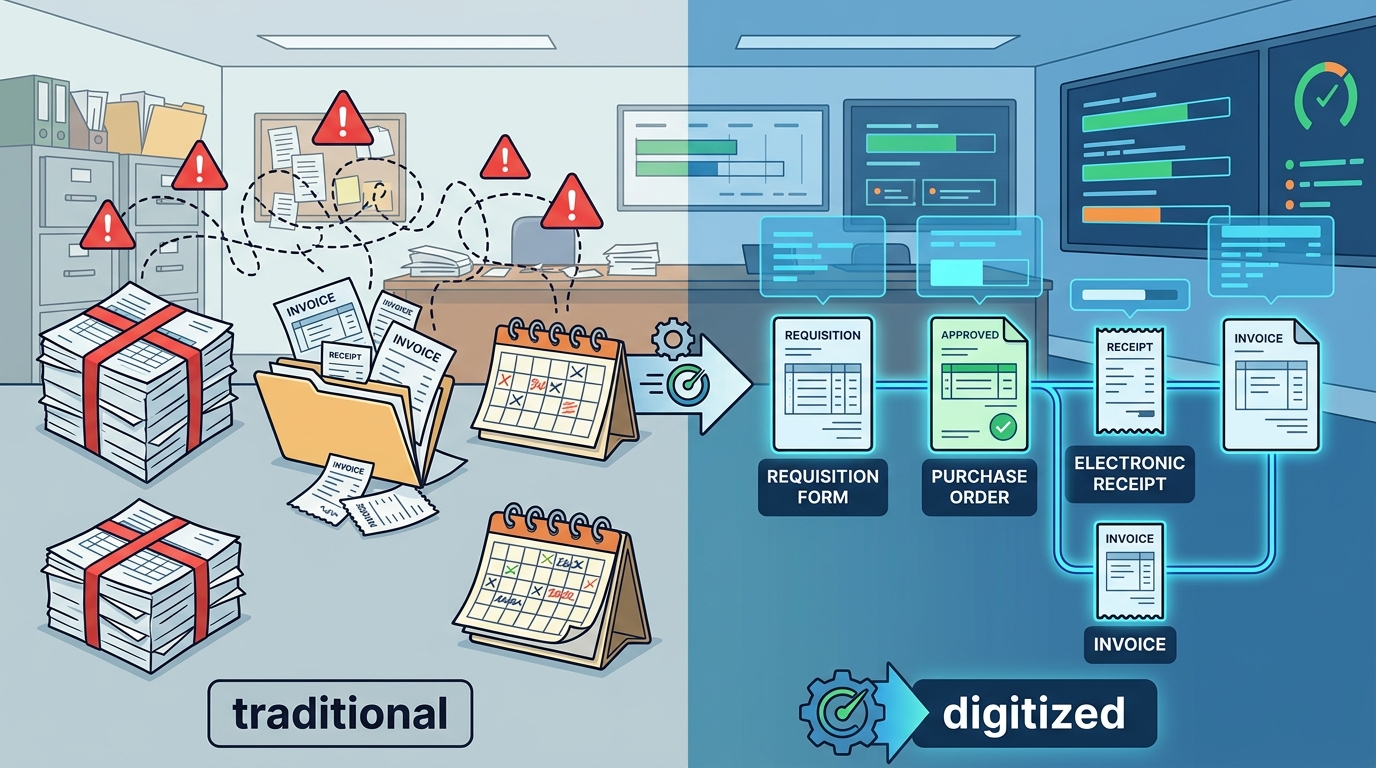
How Digitizing P2P Improves Spend Visibility
Digitization is the process of converting manual, paper-based procurement activities into automated electronic workflows. When applied to P2P, it creates a single source of truth for every transaction across the organization.
Centralized Data Capture
A digital procurement platform captures every requisition, approval, purchase order, and invoice in one system. Eyvo's digital procurement solution efficiently handles purchasing, supplier management, inventory control, and invoicing, guaranteeing full visibility and transparency with better cost control in procurement operations.
Real-Time Analytics and Reporting
With eProcurement, organizations achieve transparency on spending, purchasing, costs, and expenses. Eyvo's AI-powered platform delivers spend forecasting and real-time analytics, enabling procurement teams to make quicker and more informed decisions. This shifts procurement from reactive reporting to predictive intelligence.
Strengthening Budget Control Through Automation
Budget control is the practice of enforcing spending limits and approval hierarchies before purchases are committed. Digital P2P systems enforce this automatically at the point of requisition.
Pre-Purchase Budget Checks
Eyvo's system shows available budgets before placing an order, giving approvers and requestors immediate clarity on whether a purchase fits within allocated funds. This prevents overspending before it happens, rather than discovering it after the invoice arrives.
Multi-Level Approval Workflows
The Purchase Requisition Module supports cost splitting with budget checks, attachments, and multi-level approvals. These configurable workflows ensure that higher-value purchases receive appropriate oversight while low-value requests move quickly through the system.
The Role of Invoice Matching and Closed-Loop Procurement
Closed-loop procurement is a checks-and-balances approach where every transaction is validated from request through to payment. It ensures you only pay for what you ordered and received.
Eyvo's invoicing module allows a 3-way and even 4-way match on transaction data, verifying that the order value matches the received value for goods or services, and that this matches the invoiced and payment values. This automated matching eliminates overpayments and catches discrepancies before they become costly errors.
According to Eyvo's closed-loop framework, the objective is to ensure you only get invoiced for what you ordered and you only pay for what you received. When all four data points align, the loop is closed and the transaction is complete.
Reducing Maverick Spend with Digital Controls
Maverick spend is any purchasing activity that occurs outside an organization's approved procurement processes, such as buying from unapproved vendors or bypassing approval workflows. It is one of the most persistent drains on procurement budgets.
The Scale of the Problem
Research from The Hackett Group found that many companies lose 10 to 20% of their targeted savings due to maverick buying. A WBR Insights study found that 91% of procurement leaders view maverick spend as a challenge, with 39% seeing it as very significant.
How Digital P2P Prevents It
eProcurement platforms address maverick spending by enforcing approved supplier catalogs, routing every request through defined approval chains, and flagging non-compliant transactions in real time. Eyvo helps businesses avoid maverick spending by implementing a robust solution while providing tools to ensure procurement processes remain compliant and efficient. When the compliant path is faster than the non-compliant path, employees naturally follow it.
Key Takeaways
- Digitizing the P2P cycle creates a single source of truth for all procurement transactions, enabling real-time spend visibility across departments.
- Automated pre-purchase budget checks prevent overspending before orders are placed, strengthening financial control.
- 3-way and 4-way invoice matching ensures organizations only pay for what they ordered and received, reducing payment errors.
- Maverick spend, which can erode 10 to 20% of negotiated savings, is best controlled through enforced digital approval workflows and approved supplier catalogs.
- Closed-loop procurement ties requisitions, purchase orders, receipts, and invoices together into one auditable trail.
- AI-powered analytics transform spend data into predictive insights for smarter procurement decisions.
- Modular eProcurement platforms let organizations adopt only the capabilities they need, reducing implementation complexity and cost.
Frequently Asked Questions
What is the purchase-to-pay cycle?
The purchase-to-pay cycle is the end-to-end process covering requisition, approval, purchase order creation, goods receipt, invoice verification, and supplier payment. It governs how an organization procures and pays for goods and services.
How does digitizing P2P improve spend visibility?
Digital P2P systems capture every transaction electronically in a centralized platform, providing real-time dashboards and reports on spend by category, supplier, department, and budget. This replaces fragmented spreadsheets and delayed manual reporting.
What is maverick spend and why does it matter?
Maverick spend refers to purchases made outside approved procurement processes or from non-contracted suppliers. It matters because companies can lose 10 to 20% of their targeted savings due to off-contract buying, according to The Hackett Group.
What is closed-loop procurement?
Closed-loop procurement is a framework where every transaction is tracked and validated across four checkpoints: requisition, purchase order, goods receipt, and invoice payment. When all four match, the loop is closed and the transaction is fully reconciled.
How does invoice matching reduce costs?
Automated 3-way and 4-way invoice matching compares purchase order values, received quantities, invoiced amounts, and payment figures. Discrepancies are flagged automatically, preventing overpayments and duplicate invoices before funds leave the organization.
Can small organizations benefit from digital P2P?
Yes. Modular eProcurement platforms like Eyvo allow organizations to select only the modules they need, making digital P2P accessible and cost-effective regardless of company size.
What role does AI play in the P2P cycle?
AI enhances P2P by automating spend classification, powering OCR-based invoice scanning, comparing supplier quotes, and delivering predictive spend analytics. This enables faster processing and more strategic decision-making.
How quickly can organizations see ROI from P2P digitization?
Many organizations see measurable improvements within the first quarter of deployment, including faster approval cycles, reduced invoice processing errors, and immediate visibility into previously hidden spend categories.
Take Control of Your Spend Today
If your procurement team is still relying on spreadsheets and email approvals, you are leaving savings on the table and exposing your organization to unnecessary risk. Explore Eyvo's eProcurement platform to see how digitizing your purchase-to-pay cycle can deliver real-time spend visibility, stronger budget control, and measurable cost savings. Request a demo today.