

Digitizing the Purchase-to-Pay Cycle: How to Improve Spend Visibility and Budget Control
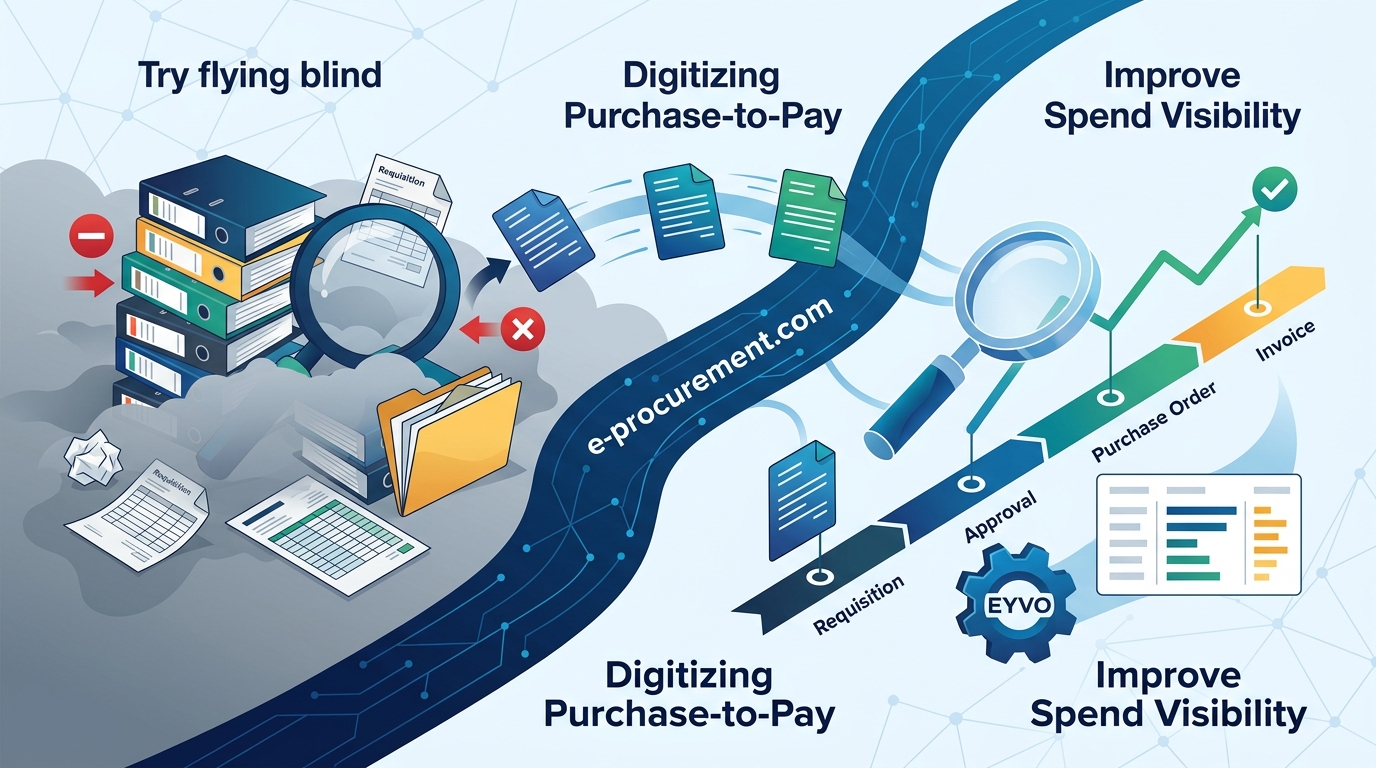
Organizations that still rely on paper forms, spreadsheets, and email approvals for purchasing are flying blind. Without a single source of truth for every requisition, purchase order, and invoice, finance teams struggle to answer basic questions: How much have we committed? Are we on budget? Where is our money going? Digitizing the purchase-to-pay (P2P) cycle solves these problems by replacing manual hand-offs with automated, data-rich workflows. In this guide, we break down exactly how a digital P2P process delivers real-time spend visibility, tighter budget control, and measurable cost savings.
What Is the Purchase-to-Pay Cycle?
The purchase-to-pay cycle is the end-to-end process an organization follows to request, approve, order, receive, and pay for goods and services. It is the backbone of procurement operations that connects internal stakeholders, purchasing teams, and suppliers in a single transactional flow. A well-managed P2P cycle ensures that every dollar spent is authorized, tracked, and reconciled.
The typical stages include requisition creation, approval routing, purchase order issuance, goods receipt, invoice matching, and payment execution. As Eyvo's closed-loop procurement approach puts it: request it, order it, receive it, pay for it. The goal of a 4-way match is to ensure you only pay for what you ordered and received.
The Spend Visibility Gap in Manual Procurement
When procurement runs on paper requisitions and email approvals, there is no single view of committed spend. Budget holders often discover overspend only when the invoice arrives. According to the Ardent Partners State of Source-to-Pay Digitization 2025 report, 48% of CPOs say better data visibility and analytical capabilities would be the most effective way to improve procurement performance.
Common Pain Points
- No accountability or strong audit trail for who authorized a purchase
- Discrepancies between estimated requisition costs and final PO values
- Duplicate data entry across disconnected systems
- Delayed recognition of maverick spending
These issues are not hypothetical. As highlighted in Eyvo's guide on whether to approve the requisition or the purchase order, many companies let budget holders sign off on meaningless requisitions rather than the legally binding PO, which creates a gap between what was approved and what was actually spent.
How Digitization Closes the Gap
Digitization is the process of converting manual, paper-based procurement activities into electronic workflows managed through software. A digital P2P platform replaces scattered spreadsheets with a centralized system where every transaction is captured, time-stamped, and linked.
Single Point of Entry
With a digital system, the requisition becomes the single point of entry. It is then converted to a purchase order, routed through automated approvals, and emailed to the supplier with minimal delay. Because the process is entirely electronic, there are no data-entry errors between steps, and approvals are delivered instantaneously.
Real-Time Spend Tracking
Eyvo's spend tracking and budgeting tools give procurement teams real-time insight into committed and actual spend, alerting managers before budgets are breached. This proactive approach is far more effective than the common practice of tracking spend only after invoices have been received.
Transparency Across Departments
With eProcurement, organizations achieve transparency on spending, purchasing, costs, and expenses. Teams receive real-time statistics on business performance, including unauthorized purchases and corporate expenses, as outlined in Eyvo's business benefits of eProcurement overview.
Strengthening Budget Control with Automation
Budget control is the practice of setting spending limits by department, project, or cost center and enforcing those limits through approval workflows. Digital P2P platforms enforce budget discipline at the point of requisition, not after the invoice arrives.
Eyvo's Purchase Requisition Module supports cost splitting with budget checks, multi-level approvals, and business rules that prevent users from exceeding their spending authority. A centralized control point not only helps curtail unapproved spending but also provides overall spend visibility through management reports.
Automated 3-way invoice matching further protects budgets by verifying that invoice amounts align with PO values and received quantities. Eyvo's procurement software matches invoices, purchase orders, and receiving documents automatically, eliminating invoicing errors and preventing overpayments.
Key Data Points: Manual vs. Digital P2P
| Metric | Manual Process | Digitized P2P |
|---|---|---|
| Invoice processing cost | $12.88 per invoice (average) | $2.78 per invoice (best-in-class) |
| CPOs increasing tech budget (2025) | 30% (2024) | 53% (2025) |
| Cost savings target achievement | 80% (followers) | 96% (Digital Masters) |
| Spend per FTE improvement with AI | Baseline | 25-40% efficiency gain |
| Data visibility as top priority | N/A | 48% of CPOs |
Sources: Ardent Partners 2025, Deloitte 2025 Global CPO Survey via Ivalua.
AI and Analytics in Modern P2P Platforms
Artificial intelligence is rapidly becoming a core feature of P2P platforms. According to the Ardent Partners 2025 report, 72% of CPOs believe AI's impact on procurement will be transformational or significant. Nearly half of all CPOs already use AI in some form today.
Spend Forecasting
AI-powered procurement software analyzes historical data to forecast future spend, flag anomalies, and suggest cost-saving opportunities. Eyvo's AI-driven platform provides spend forecasting, efficient supplier selection, and enhanced invoicing for better audits.
Dashboard Analytics
Modern dashboards with movable widgets let procurement leaders monitor committed spend, PO status, supplier performance, and budget utilization in real time. Eyvo's platform delivers real-time spend analytics for smarter decisions, enabling organizations to report on spend by category, division, country, vendor, or business unit.
Key Takeaways
- The purchase-to-pay cycle is the end-to-end procurement process from requisition to supplier payment.
- Manual P2P processes create spend visibility gaps that lead to budget overruns and maverick spending.
- Digital P2P platforms provide a single point of entry and real-time tracking that eliminates data silos.
- Best-in-class organizations process invoices at $2.78 each versus $12.88 for average performers.
- Organizations that invest in procurement digitization achieve cost savings targets 96% of the time.
- 48% of CPOs cite better data visibility as their top lever for improved performance.
- AI-driven capabilities can unlock an additional 25-40% efficiency improvement in procurement operations.
Frequently Asked Questions
What is the purchase-to-pay cycle?
The purchase-to-pay (P2P) cycle is the complete procurement process that begins with a purchase requisition and ends with supplier payment. It encompasses requisition approval, purchase order creation, goods receipt, invoice matching, and payment execution.
How does digitizing P2P improve spend visibility?
Digitization replaces paper-based hand-offs with a centralized electronic platform where every transaction is tracked in real time. This gives procurement and finance teams immediate insight into committed, actual, and forecasted spend across the organization.
What is a 4-way match in procurement?
A 4-way match is a verification process that ensures you only get invoiced for what you ordered and only pay for what you received. It compares the requisition, purchase order, goods receipt, and invoice to confirm alignment before payment is released.
How much can organizations save by automating invoice processing?
According to Ardent Partners, best-in-class organizations process invoices at $2.78 each, compared to $12.88 for average performers. That represents a 78% cost reduction per invoice.
What role does AI play in modern P2P platforms?
AI enhances P2P platforms through spend forecasting, anomaly detection, automated supplier selection, and contract analysis. The Ardent Partners 2025 report found that 72% of CPOs expect AI to have a transformational or significant impact on procurement.
Can small businesses benefit from P2P digitization?
Yes. Cloud-based eProcurement solutions like Eyvo offer modular pricing, meaning organizations only pay for the features they need. This makes digital P2P accessible to businesses of all sizes, not just large enterprises.
How does digital P2P support compliance and audits?
A digital P2P system creates a complete audit trail from requisition to payment. Every approval, change, and receipt is documented electronically, supporting SOX compliance and other regulatory requirements.
What is the first step to digitizing our P2P process?
Start by mapping your current procurement workflow and identifying manual bottlenecks. Then evaluate eProcurement platforms that offer the modules you need, such as requisitions, PO management, invoice matching, and budget controls.
Ready to Gain Full Spend Visibility?
Stop chasing paper trails and start making data-driven procurement decisions. Explore Eyvo's AI-powered procurement software to see how a digital P2P platform can transform your spend visibility and budget control. Request a personalized demo today.