

Digitizing the Purchase-to-Pay Cycle: How It Improves Spend Visibility and Budget Control
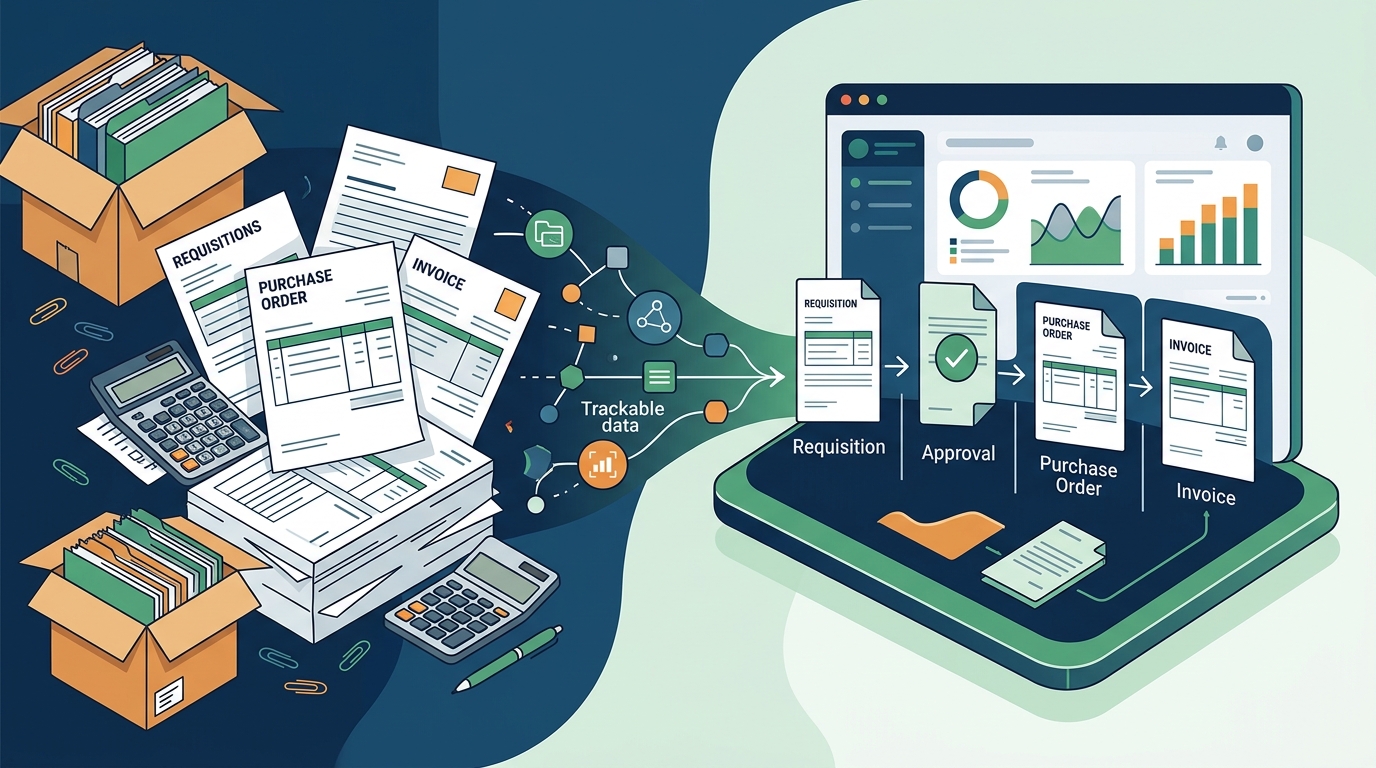
Organizations still running paper-based or spreadsheet-driven procurement processes face a persistent problem: they cannot see where their money goes until it is already spent. Digitizing the purchase-to-pay (P2P) cycle solves this by converting every requisition, approval, purchase order, and invoice into trackable data. The result is real-time spend visibility, tighter budget control, and dramatically fewer errors. In this guide, we break down exactly how a digital P2P process works, the measurable gains it delivers, and how to get started with the right eProcurement platform.
What Is the Purchase-to-Pay Cycle?
The purchase-to-pay cycle is the end-to-end process an organization follows to request, approve, order, receive, and pay for goods and services. It begins when an employee identifies a need and ends when the supplier invoice is settled. P2P is sometimes called procure-to-pay, and it is the backbone of procurement operations. As Eyvo explains in its procure-to-pay overview, this process allows businesses to obtain essential goods and services while upholding strict procurement policies.
Core Stages of P2P
A typical P2P cycle includes requisition creation, multi-level approval, purchase order generation, goods receipt, three-way invoice matching, and payment. Each stage produces data that, when captured digitally, feeds into a unified spend record.
The Spend Visibility Gap in Manual Procurement
Manual procurement relies on paper forms, email chains, and disconnected spreadsheets. This creates blind spots. According to McKinsey research, many executives report they have a limited view of total spend, too much inaccurate data, and difficulty integrating data from multiple sources. Without a centralized system, budget holders often learn about overspending only after invoices arrive.
Common Pain Points
Paper-based systems present significant work for accounts payable staff. As noted in Eyvo's guide on eProcurement for local governments, organizations need tools for tracking spend against budgets to avoid potential overspends. Lack of accountability and audit trails also makes it impossible to trace who authorized a given purchase.
How Digitizing P2P Improves Spend Visibility
Spend visibility is the ability to see, categorize, and analyze all organizational expenditure in real time. When you digitize the P2P cycle, every transaction is automatically logged, classified, and made available for reporting.
Centralized Data Capture
Digital requisition forms capture item details, cost centers, and budget codes at the point of request. Eyvo's Purchase Requisition Module supports catalogue selection, free-text entries, cost splitting with budget checks, and multi-level approvals, enforcing business rules from the very first step.
Real-Time Dashboards and Analytics
A centralized control point not only helps curtail unwanted spending but also assists in seeing overall spend through management reports. With eProcurement software, you achieve transparency on spending, purchasing, costs, and expenses. Eyvo's procurement software provides automated, cloud-based purchasing tools that deliver real-time spend visibility.
Audit Trails and Accountability
Every digital purchase order creates an auditable record. As Eyvo's Purchase Order Software page explains, a purchase order document allows for easier auditability, traceability, and accountability, which is essential for organizations concerned with SOX compliance.
Strengthening Budget Control Through Automation
Budget control is the practice of setting spending limits and enforcing approval workflows to prevent unauthorized or excessive expenditure. Digitizing the P2P cycle makes budget enforcement automatic rather than reactive.
Pre-Spend Approval Workflows
With digital workflows, budget holders sign off on final purchase orders before they reach the supplier. Eyvo recommends approving the purchase order rather than just the requisition because the PO is a legal contract, and its cost may differ from the initial estimate. This ensures the actual commitment is authorized.
Automated Budget Checks
The system can automatically reject or flag requisitions that exceed a department's remaining budget. This prevents overspending before it happens, rather than discovering it during month-end reconciliation.
Manual vs. Digital P2P: A Side-by-Side Comparison
| Dimension | Manual P2P | Digital P2P |
|---|---|---|
| Requisition Time | 3+ days (paper routing) | Minutes (electronic workflow) |
| Spend Visibility | Retrospective, fragmented | Real-time, centralized |
| Budget Enforcement | Manual checks, error-prone | Automated limits and alerts |
| Invoice Matching | Manual, high error rate | Automated 2- or 3-way matching |
| Audit Trail | Paper files, hard to trace | Full digital log per transaction |
| Maverick Spending | Difficult to detect | Flagged and blocked by policy rules |
| Reporting | Spreadsheets compiled monthly | On-demand dashboards by category, vendor, or department |
This comparison reflects the contrast explored in Eyvo's article on eProcurement versus traditional procurement, where a simple $1,000 office-supply purchase illustrates the difference in cycle time and control.
ROI and Industry Evidence
The business case for P2P digitization is well documented. Deloitte's 2025 Global CPO Survey found that organizations investing in both digital tools and talent (called "Digital Masters") reported that 96% exceeded or met cost-savings plans, compared to only 80% of followers. In its 2023 CPO survey, 84% of CPOs cited spend and savings analytics as highly impactful.
McKinsey benchmarking shows that top procurement performers have maturity scores at least 40% higher than average in strategy, digital, and data analytics. One petrochemical company that invested in digital tools and analytics exceeded its targets, reducing spend by $120 million per year with an average savings of 12%. Meanwhile, McKinsey notes that AI-driven procurement analytics can unlock around 20% savings potential.
These numbers confirm what procurement teams already feel: without digital visibility, savings stay hidden.
Key Takeaways
- The purchase-to-pay cycle covers every step from requisition to supplier payment, and digitizing it replaces guesswork with data.
- Real-time spend dashboards let finance teams spot budget variances as they happen, not weeks later.
- Automated approval workflows enforce spending limits before purchase orders reach suppliers.
- Three-way invoice matching reduces overpayment, duplicate invoices, and fraud risk.
- Deloitte's 2025 survey shows digitally mature procurement teams significantly outperform peers on cost savings.
- McKinsey data indicates top-quartile procurement organizations invest heavily in digital infrastructure and analytics.
- Eyvo's cloud-based eProcurement platform provides the requisition, PO, and analytics modules needed to digitize the full P2P cycle.
Frequently Asked Questions
What is purchase-to-pay digitization?
Purchase-to-pay digitization is the process of replacing manual, paper-based procurement workflows with electronic systems that automate requisitions, approvals, purchase orders, goods receipts, and invoice payments. It creates a single digital record for every transaction.
How does P2P digitization improve spend visibility?
By capturing every procurement transaction electronically, a digital P2P system allows organizations to track spending in real time, monitor vendor performance, and identify cost-saving opportunities through centralized dashboards and analytics.
What is the difference between a requisition and a purchase order?
A purchase requisition is an internal request to buy something. A purchase order is a legally binding contract between your organization and a supplier. Budget holders should approve the final PO to ensure the committed cost is accurate.
Can small businesses benefit from P2P automation?
Yes. Cloud-based eProcurement platforms like Eyvo's eBuyerAssist are designed for businesses of all sizes. They offer scalable modules so even small teams can enforce budget controls and gain spend visibility without large IT investments.
How much can organizations save by digitizing procurement?
Results vary, but McKinsey research documents cases where companies achieved 12% average savings on targeted spend categories after digital transformation. Deloitte reports that digitally advanced procurement functions consistently exceed cost-savings goals at higher rates than their peers.
What role does AI play in modern P2P systems?
AI enhances P2P by automating invoice matching, flagging anomalies, predicting demand, and providing spend analytics. According to Deloitte's 2025 survey, 92% of CPOs are planning or assessing generative AI capabilities for procurement.
How long does it take to implement a digital P2P system?
Implementation timelines depend on organizational complexity. Cloud-based solutions like Eyvo can typically be deployed in weeks rather than months because they do not require heavy on-premise infrastructure.
Is P2P digitization relevant for the public sector?
Absolutely. Local governments and public agencies need strict budget oversight and audit trails. Digital P2P tools help track spend against budgets, automate approval workflows, and resolve invoice discrepancies electronically.
Take Control of Your Spend Today
If your organization still relies on paper forms and spreadsheets to manage purchasing, you are leaving savings on the table. Eyvo's AI-powered eProcurement platform gives you the tools to digitize your entire purchase-to-pay cycle, from requisition to payment, in one cloud-native system. Schedule a free demo and see how real-time spend visibility transforms budget control.