

Finance and procurement leaders consistently cite the same two frustrations: they cannot see where money is going fast enough, and they cannot stop budget overruns before they happen. Both problems trace back to a manual, fragmented purchase-to-pay (P2P) cycle. Digitizing that cycle—from requisition through invoice settlement—eliminates information black holes and gives every stakeholder a real-time financial picture.
This guide explains exactly how each stage of a digital P2P workflow contributes to spend visibility, why that visibility translates directly into tighter budget control, and what metrics you should track to prove ROI.
What Is the Purchase-to-Pay Cycle?
The purchase-to-pay process covers every step an organization takes to acquire goods or services and pay the supplier. It begins with need identification and ends with payment settlement. Specifically, the cycle includes requisitioning, vendor selection, purchase-order creation, goods receipt, invoice processing, and payment execution.
In many companies these steps span multiple departments, systems, and approval hierarchies—making the flow inherently complex and data-rich. When managed manually, that complexity becomes a breeding ground for errors, maverick spending, and budget surprises.
Why Manual P2P Destroys Visibility
Before exploring the digital alternative, it helps to understand what goes wrong with paper-based or spreadsheet-driven procurement.
- Delayed spend recognition — You may not know money has been committed until the invoice lands, sometimes weeks after the purchase.
- Inconsistent coding — Different people code the same item to different GL accounts, making category-level analysis unreliable.
- Maverick and off-contract spend — Purchases made outside preferred vendors bypass negotiated pricing and compliance controls.
- Unclear accruals — The gap between what has been ordered, received, and billed is invisible, causing budget-variance surprises at month-end.
Without a centralized system, gaining real-time visibility into spending patterns across departments is nearly impossible. Organizations lack control over shadow purchases, redundant subscriptions, and unoptimized usage—often resulting in overpaying or missing volume discounts.
Five Ways Digitization Unlocks Spend Visibility
1. Centralized Data Capture Across Every Transaction
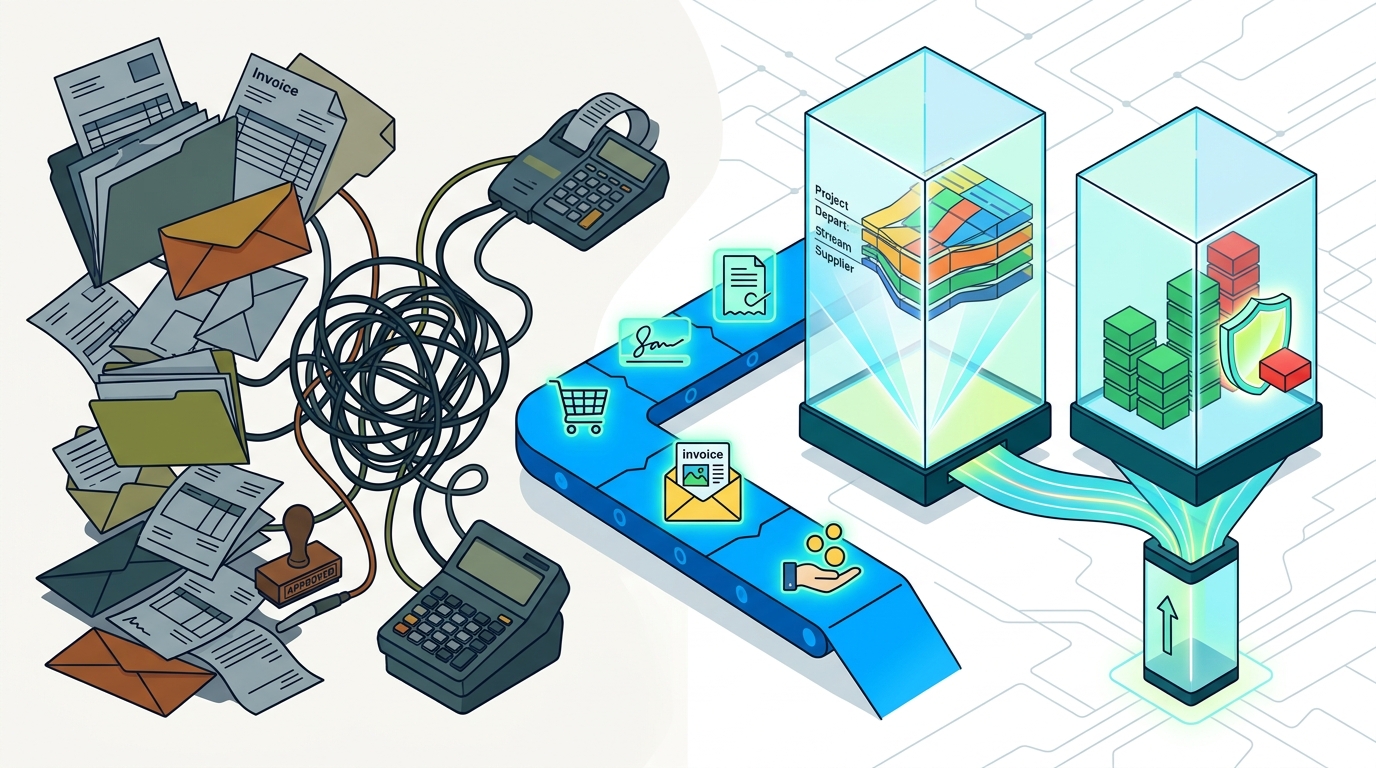
A digital P2P platform records data at every step—requisition, PO, goods receipt, and payment. This creates a single source of truth that eliminates data silos and gives procurement, finance, and business-unit leaders consistent numbers to work from. Spend analytics then ensures that data provides procurement teams with the insights needed to make strategic decisions.
2. Real-Time Dashboards and Spend Cubes
Digitized procurement data feeds live dashboards that answer three foundational questions: Where is the organization buying (supplier concentration)? What is it buying (category-level distribution)? Who is buying (cost-center attribution)? These three dimensions form the spend cube—the analytical foundation for every sourcing and budgeting decision.
3. Automated Three-Way Matching
When POs, goods receipts, and invoices are matched electronically, discrepancies surface immediately rather than during a quarterly audit. Automation has been shown to improve invoice accuracy by approximately 39 percent and reduce approval bottlenecks across roughly 31 percent of workflows. This speed matters because every unresolved discrepancy is a pocket of invisible spend.
4. Payment Analytics and Cash-Flow Forecasting
Digital payment tracking provides multiple views into supplier payments, including early and late payment monitoring. Whether a payment is 30 days late or seven days early, every invoice impacts cash flow and budgeting. Real-time payment data lets treasury teams optimize working capital instead of reacting to surprises.
5. AI-Powered Spend Classification
Modern P2P platforms use artificial intelligence to classify spend automatically, even when item descriptions vary across business units. AI-powered spend classification and data enrichment uncover granular insights, enabling strategic sourcing decisions and identifying cost-saving opportunities that manual tagging would miss.
How Visibility Converts Into Budget Control
Visibility alone is not the end goal—actionable control is. Here is how each visibility gain tightens the budget.
| Visibility Gain | Budget-Control Mechanism | Practical Example |
|---|---|---|
| Live requisition tracking | Pre-approval budget checks reject requests that exceed remaining allocation | A facilities team's cleaning-supply order is auto-routed back because the quarterly budget is 92 percent consumed |
| Category spend dashboards | Procurement can consolidate fragmented suppliers and negotiate volume discounts | Merging three IT-services vendors into one contract saves 14 percent annually |
| Automated invoice matching | Duplicate and inflated invoices are flagged before payment | A duplicate freight invoice for $18,400 is caught and rejected in real time |
| Committed-spend reporting | Finance separates committed versus variable spend for tighter forecasting | CFO adjusts Q3 forecast mid-quarter based on PO commitments already in the system |
| Supplier-performance KPIs | Under-performing vendors are replaced before cost overruns compound | Late-delivery data triggers a sourcing review that cuts expediting fees by 22 percent |
Key KPIs to Track After Digitization
Measuring the impact of your P2P digitization programme requires the right metrics. Essential KPIs include:
- Cycle time — Days from purchase requisition approval to PO approval, and from invoice receipt to payment.
- First-time match rate — Percentage of invoices that pass three-way matching without manual intervention.
- Maverick-spend ratio — Share of total spend occurring outside contracted suppliers or catalogues.
- On-time payment percentage — Measures both supplier-relationship health and early-payment discount capture.
- Budget variance by category — Deviation between planned and actual spend at the GL or category level.
- Electronic PO adoption rate — Percentage of purchase orders generated digitally versus manually.
The Role of ERP Integration
A P2P platform delivers maximum value when it feeds data into—and pulls data from—your ERP and accounting systems. Integration with ERP systems affects approximately 63 percent of purchasing operations, reinforcing the strategic role of P2P solutions within enterprise finance transformation. Seamless integration enables automatic journal entries, real-time budget consumption updates, and consolidated reporting across entities.
Market Context: P2P Solutions Are Scaling Fast
Organizations are investing heavily in this space. The global P2P solutions market is projected at roughly USD 8.3 billion in 2026 and is anticipated to reach nearly USD 14 billion by 2035, registering a CAGR of approximately 6.8 percent. This growth is driven by enterprise demand for end-to-end procurement visibility, invoice automation, and spend control across complex supply chains.
On the accounts-payable side, AP automation is expanding at a CAGR of 12.8 percent from 2024 to 2030, while manual invoice entry has dropped from 85 percent to 60 percent in just one year—a clear signal that digital P2P is becoming table stakes.
Implementation Roadmap: Six Practical Steps
- Audit your current state — Map every requisition-to-payment touchpoint, identify manual hand-offs, and quantify error rates.
- Define spend taxonomy — Standardize category codes and GL mappings before loading them into a new platform.
- Select a platform with native analytics — Prioritize solutions that include spend-cube reporting, AI classification, and configurable approval workflows.
- Integrate with ERP and banking systems — Ensure bidirectional data flow so that budget consumption updates in real time.
- Configure policy rules — Encode budget thresholds, preferred-supplier lists, and escalation paths into automated workflows so that wasteful or unnecessary expenditure is quickly identified and rejected before any costs are incurred.
- Launch, measure, iterate — Track KPIs from day one and use variance data to refine approval thresholds and category strategies quarterly.
Common Pitfalls to Avoid
- Automating a broken process — Digitizing without first eliminating redundant approval layers simply accelerates dysfunction.
- Ignoring tail spend — High-value categories get attention, but low-value, high-frequency purchases often harbour the most maverick spend.
- Under-investing in change management — Adoption falters when end users see the platform as a policing tool rather than a productivity enabler.
- Siloed deployment — Rolling out e-procurement without connecting accounts payable creates a new data gap rather than eliminating one.
Key Takeaways
- The P2P cycle generates data at every step; digitization converts that data into a continuous, real-time spend signal.
- Spend visibility enables proactive budget control—pre-approval checks, automated matching, and committed-spend reporting all prevent overruns before they happen.
- AI-powered classification and analytics surface savings opportunities that manual processes miss entirely.
- ERP integration is non-negotiable for real-time budget consumption and consolidated reporting.
- The market is moving fast: P2P solution adoption is growing at nearly 7 percent CAGR, and AP automation even faster at 12.8 percent.
Frequently Asked Questions
What is the purchase-to-pay cycle?
The purchase-to-pay (P2P) cycle is the end-to-end process that covers all activities related to acquiring goods and services—from identifying the need, through requisition, purchase-order creation, goods receipt, and invoice processing, to final supplier payment.
How does digitizing P2P improve spend visibility?
Digitization captures data at every transaction stage and feeds it into centralized dashboards and spend cubes. This gives procurement and finance teams real-time insight into who is buying, what they are buying, and from which suppliers—eliminating the blind spots that manual processes create.
What budget-control benefits does P2P automation deliver?
Automated P2P workflows enforce pre-approval budget checks, flag duplicate or inflated invoices through three-way matching, separate committed from variable spend for better forecasting, and surface maverick purchasing before it erodes negotiated savings.
Which KPIs should I track after digitizing the P2P cycle?
Focus on cycle time (requisition to payment), first-time invoice match rate, maverick-spend ratio, on-time payment percentage, budget variance by category, and electronic PO adoption rate. These metrics collectively measure both process efficiency and financial control.
How large is the P2P solutions market?
The global procure-to-pay solutions market is projected at approximately USD 8.3 billion in 2026, growing to nearly USD 14 billion by 2035 at a CAGR of about 6.8 percent, driven by demand for procurement visibility, invoice automation, and spend control.