

How to Automate the Supplier Onboarding Process and Reduce Manual Data Entry
Supplier onboarding is the process by which a company brings a new vendor into its network, verifies necessary information, assesses risk, and sets up contracts and payment methods so that supplier can officially do business. When handled manually, it involves endless spreadsheets, email chains, and re-keyed data that slow procurement teams down. Automating supplier onboarding eliminates repetitive administrative tasks, reduces errors, and gets suppliers transaction-ready faster. In this guide, you will learn exactly how to replace manual data entry with streamlined digital workflows using e-procurement tools.
Why Manual Supplier Onboarding Fails
Manual, paper-based procurement processes are time-consuming, error-prone, and hinder efficiency. Teams rely on email threads, spreadsheets, and phone calls to collect information, creating a fragmented record that is difficult to audit. Every re-keyed field is a chance for duplicate vendors, incomplete records, or outright fraud.
According to Gartner research cited by HighRadius, supplier collaboration skyrocketed in priority for 88% of procurement leaders over the past 24 months. Despite that urgency, many organizations still use age-old methods that stall operations. If your onboarding drags on, suppliers cannot begin work, which stalls procurement and project delivery timelines.
What Is Automated Supplier Onboarding?
Automated supplier onboarding is the use of digital workflows, self-service portals, and validation technology to move a vendor from initial registration to approved status with minimal human intervention. Instead of relying on manual data entry, emails, and paperwork, automation enables businesses to verify credentials, set up payment terms, and grant system access through structured workflows.
A supplier portal is at the heart of this approach. Suppliers log into a secure, self-service section where they submit business details, upload compliance documents, and maintain their own catalog and pricing data. This shifts the data entry burden from your procurement team to the supplier themselves.
Key Steps to Automate Supplier Onboarding
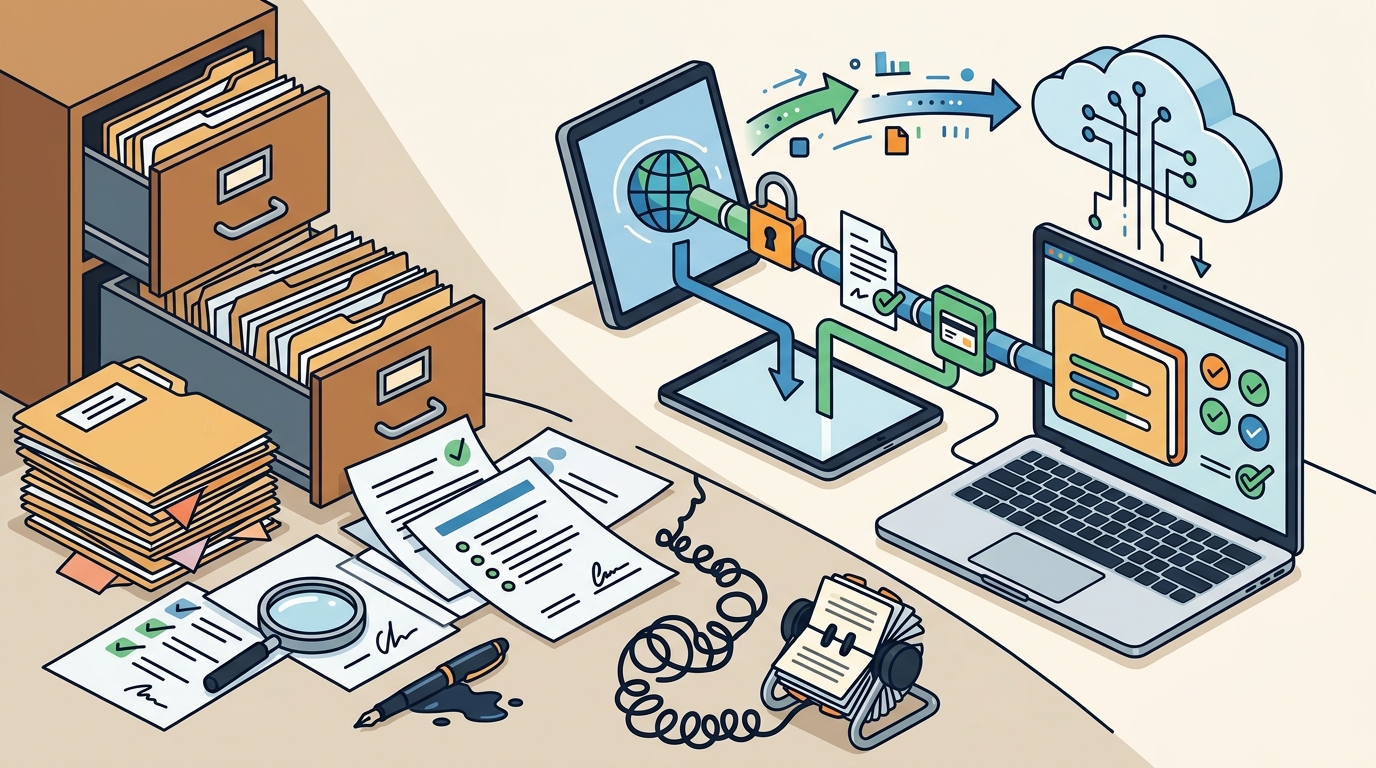
1. Deploy a Self-Service Registration Portal
Invite suppliers to register through a digital portal that collects essential business details such as company name, tax identification number, contact information, banking details, and product categories. Real-time validation flags incomplete applications immediately, reducing back-and-forth. Eyvo's vendor portal module lets suppliers maintain compliance documentation, product catalogs, and pricing in one secure location.
2. Automate Compliance and Risk Screening
Compliance screening is the systematic verification of a supplier's licenses, certifications, insurance, and tax documentation against legal and organizational standards. Use OCR, document validation, and APIs to automate retrieval of public records and flag sanctions or blacklist matches. As PaymentWorks advises for 2026, segment suppliers by risk level and use validated data sources rather than relying solely on supplier assertions.
3. Configure Approval Workflows and ERP Integration
Set automated approval workflows based on criteria such as cost codes, budget thresholds, department, or vendor category. Eyvo's platform supports custom approval workflows that route requests to the right signatories automatically. Once approved, supplier data should sync directly to your ERP (QuickBooks, SAP, Xero, or others) so procurement and finance teams always work with current information.
Must-Have Features in Onboarding Automation
When evaluating an e-procurement platform for supplier onboarding, look for these capabilities:
- Self-service supplier portal for document uploads, status tracking, and catalog management
- Configurable approval workflows with role-based routing and budget checks
- Automated document collection with expiration alerts and renewal reminders
- ERP and third-party integration via open API or file sync
- Real-time analytics dashboards showing onboarding progress and pending approvals
- Vendor risk management to ensure compliance with internal audit practices
Eyvo's modular procurement platform covers these requirements while remaining flexible enough to adapt to industry-specific workflows through custom software options.
Manual vs. Automated Onboarding: A Comparison
| Criteria | Manual Onboarding | Automated Onboarding |
|---|---|---|
| Data Entry | Re-keyed across spreadsheets and emails | Supplier self-service with real-time validation |
| Onboarding Speed | Weeks to months | Up to 70% faster (per HighRadius data) |
| Error Rate | High (duplicate vendors, missing documents) | Low (system-enforced completeness checks) |
| Compliance Verification | Ad hoc, inconsistent | Automated screening with audit trails |
| Scalability | Linear increase in headcount needed | Scales without proportional staff growth |
| Supplier Experience | Frustrating, opaque | Transparent portal with status tracking |
Measurable Benefits of Automation
Organizations that automate supplier onboarding report significant, quantifiable gains. According to HighRadius, finance teams that adopt AI-driven onboarding achieve 70% faster supplier setup and a 40% boost in accounts payable productivity.
Beyond speed, automation strengthens supplier relationships. A smooth onboarding experience sets the tone for a positive working relationship, making suppliers more likely to be responsive, compliant, and collaborative long-term. It also supports your cost reduction strategy by eliminating the overhead of repetitive manual processes across every new vendor engagement.
For growing organizations or those working with international vendors, a standardized automated process ensures consistency across geographies while adapting to region-specific regulatory requirements.
Key Takeaways
- Manual supplier onboarding creates data errors, compliance gaps, and slow time-to-transaction.
- A self-service supplier portal shifts data entry to the vendor and improves accuracy.
- Automated compliance screening uses OCR, APIs, and document validation to verify suppliers in real time.
- Configurable approval workflows route onboarding requests based on risk, spend, and department rules.
- ERP integration ensures approved supplier data flows directly into finance and procurement systems.
- Organizations report up to 70% faster onboarding and 40% higher AP productivity after automation.
- Scalable onboarding processes support global expansion without proportional headcount increases.
Frequently Asked Questions
What is supplier onboarding automation?
Supplier onboarding automation is the use of digital workflows, self-service portals, and validation tools to bring new vendors into your procurement system with minimal manual data entry. It replaces spreadsheets and email chains with structured, auditable processes.
How does a supplier portal reduce manual data entry?
A supplier portal allows vendors to log in and submit their own business details, tax documents, banking information, and product catalogs directly. This eliminates the need for procurement staff to re-key data from emails or paper forms.
What compliance checks can be automated during onboarding?
Automated checks include verifying business licenses, tax IDs (such as W-9 forms), insurance certificates, sanctions screening, and beneficial ownership verification using public registries and third-party APIs.
How long does automated supplier onboarding take?
While manual onboarding can take weeks or even months, automated workflows can reduce that timeline by up to 70%, getting suppliers transaction-ready in days rather than weeks.
Can small businesses benefit from onboarding automation?
Yes. Cloud-based procurement platforms like Eyvo are designed to scale for both small and medium-sized businesses and large enterprises, providing cost-effective tools without unnecessary complexity.
Does automated onboarding integrate with ERP systems?
Most modern e-procurement platforms integrate with ERP systems through open APIs or file sync. Eyvo, for example, integrates with QuickBooks, Sage, Xero, SAP, and other applications.
What is the ROI of automating supplier onboarding?
ROI comes from reduced processing costs per supplier, fewer data errors, faster time-to-transaction, lower compliance risk, and the ability to onboard more vendors without adding procurement staff.
How do I get started with supplier onboarding automation?
Start by mapping your current onboarding steps, identifying manual bottlenecks, and evaluating e-procurement platforms that offer supplier portals, automated workflows, and ERP integration. Request a demo to see how the system maps to your specific process.
Ready to Eliminate Manual Supplier Onboarding?
Stop re-keying supplier data and start onboarding vendors in days instead of weeks. Request a free demo of Eyvo's eBuyerAssist platform to see how automated workflows, a self-service supplier portal, and seamless ERP integration can transform your procurement operations.